Senator Karla May's May Report for the Week of Feb. 23, 2026
Friday, February 27, 2026
The Week of Feb. 23, 2026 |
On the Floor This week, the following bills were discussed on the Senate floor:
The Senate gave first round approval to the following bills:
The Senate third read and passed these bills:
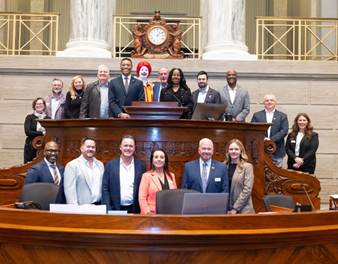
On the floor this week, I also had the opportunity to introduce McDonald's Corporation owners and operators; Ronald McDonald; and Shante Duncan, Charmane Honorable, Ausar Duncan, Truth Tsenane, Amir Duncan, Moses Duncan, and Bobby Best to recognize the economic impact McDonald’s has had on our state, as well as the thousands of jobs these restaurants provide, employing Missourians across the state.
Bills and Committees Judiciary Committee: The committee heard the following bills during this week’s hearing:
Commerce Committee: The committee heard two bills this week. Senate Bill 1065 create provisions relating to utility facility relocation. Senate Bill 1396 would repeal and create new provisions relating to discounts by electrical corporations based on megawatt load, and prevent data centers from receiving this discount.
Rules, Joint Rules, Resolutions and Ethics Committee: This week, the committee heard two resolutions. Senate Concurrent Resolution 11 urges the Missouri Congressional delegation to uphold the principles of federalism regarding the ability of states to govern their election processes and enact policies regarding campaign finance and election influence. Senate Resolution 543 modifies Senate Rule 96 to require that, no later than March 1, 2026, the Senate must provide an audio and video feed of its proceedings on the website of the Senate.
Appropriations Committee: The following departments and offices shared their funding requests for the Fiscal Year 2027 state operating budget in this week’s hearing:
Other News Judge strips ‘ballot candy’ from measure to gut initiatives In a rare ruling from the bench, a Cole County judge on Feb. 19 said he is striking the so-called “ballot candy” from the ballot language lawmakers wrote for a measure voters will decide later this year. The measure would effectively eliminate the initiative petition process by setting a higher bar for voters to ratify future constitutional amendments proposed by petition.
The judge said the first three bullet points of the Legislature’s ballot language falsely claim the measure, Amendment 4, would stop foreign adversaries from funding ballot measure campaigns, punish initiative petition fraud as a crime and require public hearings on petition measures prior to an election. As the judge noted, however, all three points merely describe existing law.
The true purpose of Amendment 4 is to require constitutional amendments placed on the ballot via initiative petition to pass in all eight of Missouri’s congressional districts in order to be ratified, but that isn’t mentioned until the ballot language’s fourth bullet point.
Currently, a simple majority of the votes cast statewide is required for passage. That standard would remain in place for amendments the Legislature puts on the ballot. According to some analysis, Amendment 4 would make it mathematically possible for just over 5% of voters to block an amendment supported by the other 95%.
The judge made his comments during a hearing on a lawsuit brought by the Missouri Association of Realtors challenging the ballot language for attempting to deceive voters as to Amendment 4’s true purpose. He is expected to issue a written ruling containing new ballot language at any time.
In a related Feb. 23 order, he also instructed the state treasurer to submit a new fiscal estimate for Amendment 4. While the order says the original estimate “does not satisfy the requirements” of state law, the judge didn’t specify how it was deficient.
Amendment 4 is scheduled to appear on the Nov. 3 statewide ballot. Once the judge issues a final decision, the state is expected to appeal his ruling to the Missouri Court of Appeals Western District. The case is T. David Rogers, et al. v. Secretary of State Denny Hoskins.
House approves extending license plates to five years Missourians would have to renew their license plates every five years instead of every two years under legislation the Missouri House of Representatives advanced to the Senate on Feb. 23 by a vote of 130-11.
House Bill 2189 also would repeal an existing requirement that vehicles with an odd-numbered model year be registered in odd-numbered calendar years and those with an even-numbered model year be registered in even-numbered years.
The odd/even mandate dates back about a quarter-century to when Missouri switched from annual to biennial vehicle registration and was intended to maintain a stable revenue stream from license fees. If all motorists would have been eligible for two-year plates the first year they were available, it would have created a spike in fee revenue the first year and major shortfall the next.
Although the passage of time has eliminated the need for such a restriction with two-year plates, the move to five-year plates could produce a disparity in annual revenue collections if large numbers of motorists shift to the longer registration period at their first opportunity.
The per-year costs of licenses would remain the same with the shift from two- to five-year plates, although motorists would have to pay for the full five years at the time of registration, instead of the current two.
Bill would permanently ban transgender kids in sports A three-year-old ban on transgender children participating in gender-segregated school athletics that is set to expire in 2027 would be made permanent under legislation the Missouri House of Representatives approved Feb. 26 on a vote of 98-37, with two lawmakers voting “present.” The measure now advances to the Senate, where similar legislation died last year for lack of final action, although the majority caucus is expected to make it a chamber priority this session.
The prohibition on transgender athletes applies to school-sponsored sports from grade school through college. While supporters claim the law is necessary to protect the integrity of girls’ sports, during the dozen years before the ban took effect during which the Missouri State High School Activities Association regulated sports participation by transgender athletes, only 10 such students sought to do so.
House Bill 1663 seeks to eliminate a scheduled expiration of the law on Aug. 28, 2027. If legislation repealing that sunset is not enacted before that time, the ban of sports participation automatically would be lifted as of that date.
House pushes for more restrictions on state, local revenue On Feb. 26, the House of Representatives voted 87-49 for a proposed constitutional amendment to impose additional restrictions on the ability of state and local governments to collect sufficient tax revenue to pay for basic services. The bill passed with just five more votes than the constitutional minimum needed to advance to the Senate.
Since 1980, the Hancock Amendment has required voter approval of all local tax increases and prohibited growth in state revenue collections from exceeding growth in Missourians’ average personal income. A subsequent amendment ratified in 1996 also bars the Legislature from imposing any significant tax hike without voter approval.
House Joint Resolution 169 would add a host of new restrictions on taxation in addition to those already in place. It is modeled on the so-called “Taxpayer Bill of Rights” enacted in Colorado in 1992 that has sharply limited state and local revenue collections in the state and led to reductions in several vital services, including education and public safety. In the 34 years since adoption in Colorado, not a single state has enacted similar legislation.
If the Senate also passes HJR 169, it would go on the Nov. 3 statewide ballot for voter approval, unless the governor exercised his constitutional authority to set an earlier election date. A handful of representatives from the majority party joined the unanimous minority party in opposing the measure in the House.
|
CONTACT INFORMATION |
Thank you for your interest in the legislative process. I look forward to hearing from you on the issues that are important to you this legislative session. If there is anything my office can do for you, please do not hesitate to contact my office at 573-751-3599. |